Joshua Keese

SIT, UAS Part 107
View My LinkedIn Profile
View My GitHub Profile
Public Transit alog Illinois Route 83
Summary: Surrounded by improved four-lane and two-lane roads with consistent sidewalks and routine public transportation, Illinois Route 83 (IL 83) is the only major arterial roadway in its area that you will see pedestrians constantly walking in its shoulder. With the new IL 83 / 137 Study published by Illinois Department of Transportation (IDOT), this is the perfect opportunity to analyze how public transportation can be optimized before construction begins. We set out to perform analysis on those areas that can be improved by additional walkways and bus routes, with emphasis on retired citizens and their routes to the nearest grocery store. As it currently stands, there is a slight correlation between age of citizens and proximity to grocery stores.
Introduction
As stated, there are not adequate amenities to navigate along IL 83 without a personal vehicle. Across the almost 9.5 miles of roadway in the study, there are only 2,000 feet of unbroken sidewalk. For the village, including sidewalks into new construction is not a requirement, as there are newly improved lots that do not include public sidewalks.
On top of this, there are no PACE bus routes that run along IL 83, and only one route crosses over it. Due to both of these factors, many people in the community are forced to walk in the shoulder. Throw in the morning road rage and commuters driving in the shoulder to gain seconds on their commute, and you end up with a recipe for disaster.
The IL 83 corridor exists as a convenient stretch of roadway for daily shopping, containing multiple goods stores, grocery stores, jewelers, dentists, and other convenient shops necessary for daily life. However, with no adequate public transportation, citizens can be forced into only experiencing their slice of the corridor. This is harmful to both the citizens and shop owners, both of which would benefit from more transportation.
What then about those that are bound by either age or wheelchair? Lack of transportation can be even more strenuous on those without the ability to reliably walk to stores. For this, we look at how the elderly are affected by the IL 83 corridor’s lack of public infrastructure.
Method and Data
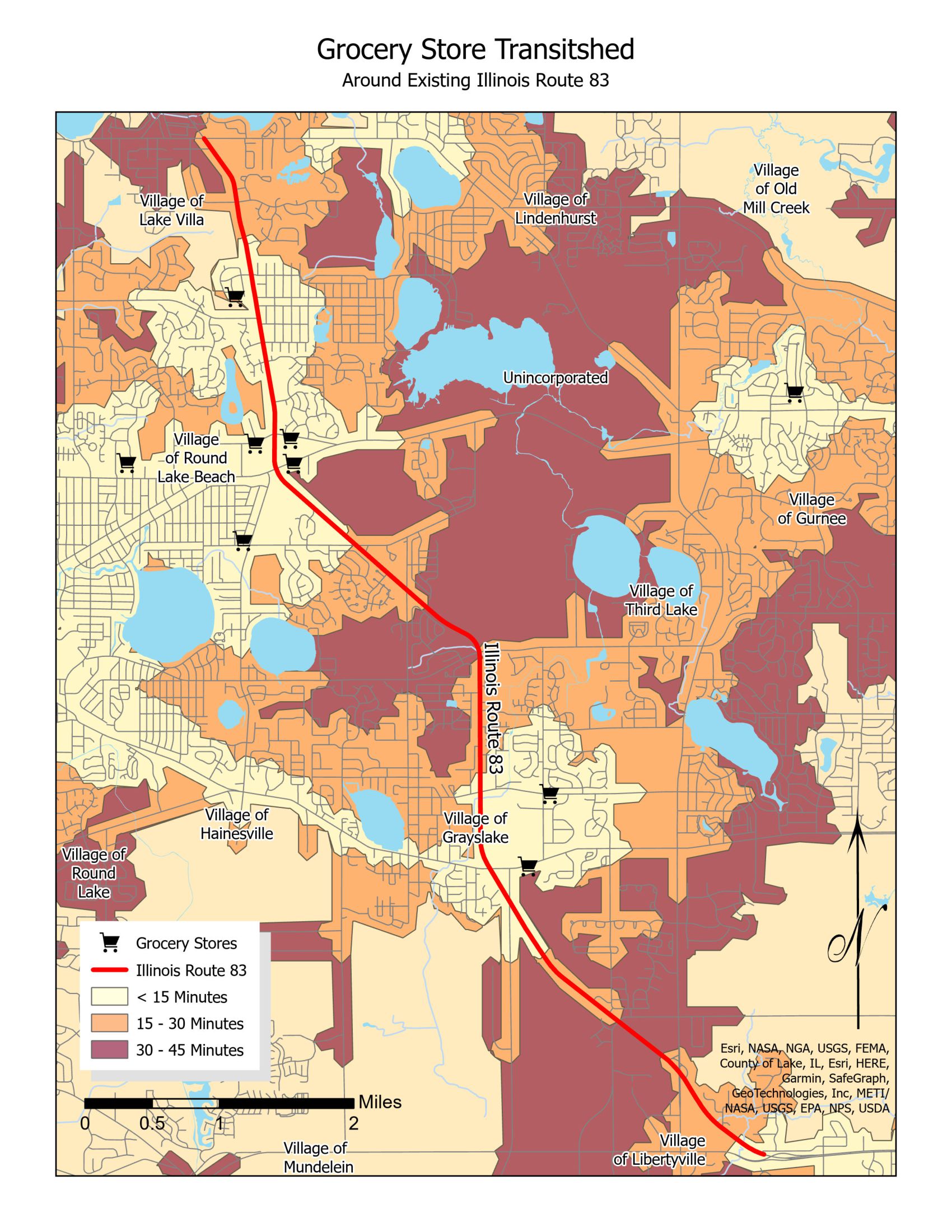
In order to analyze the currently existing IL 83 corridor, we performed a transitshed analysis on the corridor with an emphasis on surrounding grocery stores. Performing this analysis allows us to see how the lack of a bus route along IL 83 makes it more difficult for those that find themselves in an area significantly far from bus routes.
The transitshed was built using PACE GTFS data and census street data. As for comparing transitshed areas, we use census block group data. Census block groups allow us to view a small enough area that reasonably fits with the analysis site, but also large enough to house enough population data.

Discussion
As can be seen in the figures above, there is a large gap in the transitshed along IL 83 where there are both a) no grocery stores, and b) no bus routes cutting across. Even though this area does not have a low population, it still has at least a 45-minute travel time to a grocery store - and all of this will be on foot, with no available sidewalks.
With the IDOT proposal for the IL 83 widening, the hope is that this will bring along new bus routes and sidewalks to the right of way. As it currently stands, it is incredibly difficult for people in certain areas on this major arterial roadway to get to common areas, such as grocery stores.
References
Illinois Department of Transportation (IDOT). February 24, 2021. Community Advisory Group (CAG) Meeting #5 [Presentation]. Illinois Department of Transportation. https://idot.illinois.gov/content/dam/soi/en/web/idot/documents/idot-projects/district-1/il-route-83-il-route-137-study/cag5/pi_2021.2.24_cag-5_presentation_final.pdf
Pace Suburban Bus. Route Timetable Data Services. https://www.pacebus.com/route-timetable-data-services